As a top sheet metal fabrication company, Sharp Century offers professional prototype metal fabrication services in mining machinery design, manufacturing, and assembly.
Services

Design Optimization
Sharp Century utilizes lightweight materials such as high-strength alloy steels and composite materials to reduce equipment weight and lower energy consumption.

Strengthening of Critical Components
Applying heat treatment processes to load-bearing components to enhance their wear resistance and fatigue strength.

Efficiency Improvement
Deploying welding robots and CNC machining centers to increase traditional processing efficiency by over 30%.

Standardization
Establishing detailed assembly and inspection procedures to minimize human errors.

Sheet Metal Processing
The process includes material cutting → forming → joining → surface treatment → assembly and final assembly. We are ready to offer premium services in sheet metal fabrication and assembly.
Services
The manufacturing of mining machinery is a complex process that encompasses design, material processing, assembly, and testing. Below is a comprehensive introduction to the entire manufacturing process, integrating key technologies such as sheet metal processing, welding, and machining:
1. Requirement Analysis and Design Phase
2. Raw Material Preparation and Pre-treatment
3. Core Manufacturing Process
Sheet Metal Manufacturing: Material cutting → Forming → Joining
Heavy Structural Welding: Welding process selection (welding method); Quality control (pre-welding and post-welding preparations).
Machining: Machine tool processing (turning and milling); Special processes (heat treatment and surface hardening).
Assembly and Final Assembly: Sub-assembly; Final assembly and debugging.
Surface Treatment and Coating
Quality Inspection and Testing
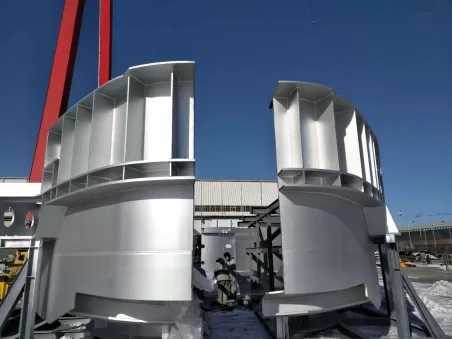
Sharp Century offers robust sheet metal fabrication capabilities to produce components that meet strict quality and performance standards.
Services
Common Issues and Solutions in Mining Equipment Fabrication:
Excessive burrs on material cutting edges
Optimize cutting parameters (reduce laser power, increase cutting speed).
Cracking or excessive springback after sheet metal bending
Adjust the bending radius (typically ≥1.5 times the sheet thickness); Orient the bending direction perpendicular to the material grain direction (avoid bending along the rolling direction); Implement bending compensation.
Welding distortion causing assembly misalignment
Use segmented welding to reduce localized heat accumulation; Employ welding fixtures to secure the workpiece; Perform mechanical straightening after welding.
Coating peeling or bubbling after painting
Perform sandblasting before painting; Control the painting environment; Use epoxy zinc-rich primer to enhance adhesion.
Excessive flatness deviation in large sheet metal components
Apply vibration stress relief after welding to eliminate residual stresses; Store large flat components vertically to prevent deformation due to self-weight.